
Can AI Search Access Your Website? Understanding Crawlers, Robots.txt, and Bot Blocking
Creating useful, authoritative website content is an important part of search visibility. But even the best content may struggle to reach potential customers if search engines and AI platforms cannot access it.
That raises an important question: Can AI search actually access your website?
A website can have well-written service pages, valuable resources, strong technical SEO, and a clear brand message, yet still experience accessibility issues for automated systems. A robots.txt directive, firewall rule, content delivery network (CDN) setting, security plugin, or bot-management configuration can affect which crawlers are able to reach your content.
This doesn’t mean every automated bot should have unrestricted access. It means managing crawler access has become an important part of a business’s SEO, AI search visibility, and website security strategy.
Not Every AI Bot Does the Same Thing
One of the biggest mistakes businesses can make is treating every AI-related crawler as though it serves the same purpose.
Different automated systems access website content for different reasons:
- Traditional search crawlers discover and process website content for search engines such as Google.
- AI search crawlers access information to support AI-powered search experiences.
- AI training crawlers collect publicly available content that may be used to develop or improve AI models.
- User-directed AI agents may visit a website in response to a specific request from someone using an AI tool.
These differences matter because website owners may want to allow certain types of access while restricting others.
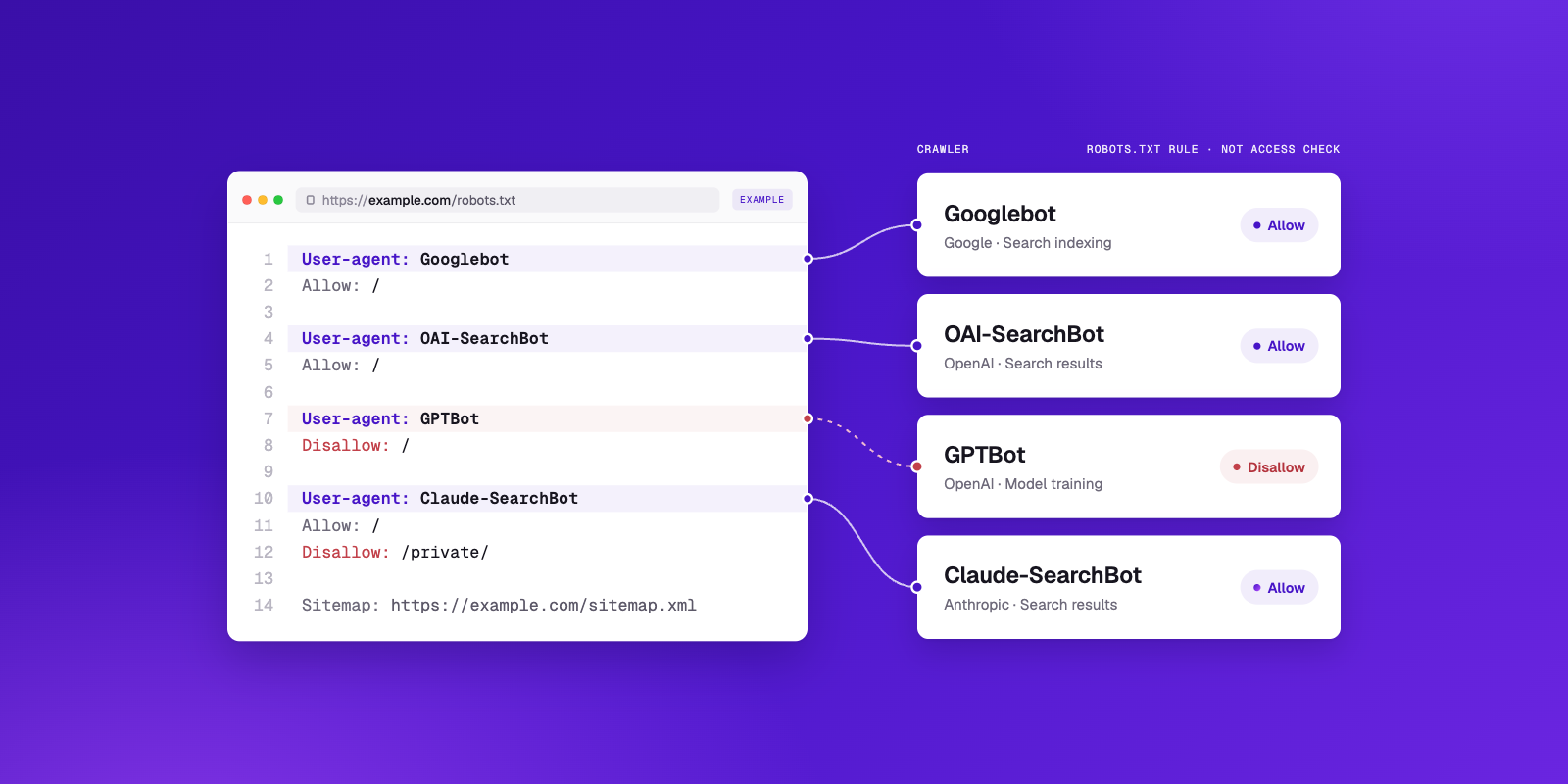
For example, OpenAI identifies OAI-SearchBot as a crawler that supports ChatGPT search discovery. Allowing this crawler helps make website content eligible to be discovered and surfaced in ChatGPT search results.
OpenAI also identifies GPTBot separately. Website owners can restrict GPTBot if they don’t want their content potentially used for AI model training.
Anthropic follows a similar approach with different crawlers for different purposes. ClaudeBot is associated with potential model training, Claude-SearchBot supports search, and Claude-User retrieves content in response to user requests.
Google also provides Google-Extended, a control that allows website owners to manage certain Gemini-related training and grounding uses. Importantly, Google states that Google-Extended doesn’t affect a website’s inclusion or ranking in Google Search.
The takeaway is simple: Not all AI crawlers serve the same purpose, and blocking one doesn’t necessarily have the same effect as blocking another.
What Does Robots.txt Actually Do?
A robots.txt file tells search engine crawlers and other automated bots which parts of your website they are allowed to access.
For example, a website may allow crawlers to access most public pages while instructing them not to crawl administrative areas, internal search results, or other sections that don’t need to appear in search.
However, there’s an important distinction: robots.txt provides instructions to crawlers. It isn’t a security system.
Google explains that robots.txt is primarily used to manage crawler traffic, not to keep sensitive information private or guarantee that a URL won’t appear in search results.
A blocked URL may still be discovered through links elsewhere, and not every automated bot will respect robots.txt instructions.
Confidential or sensitive content should be protected through proper security measures, such as authentication and access restrictions, rather than relying solely on robots.txt.
Crawling, Indexing, and AI Visibility Are Different Steps
The terms crawling, indexing, and visibility are often used interchangeably, but they mean different things.
Crawling happens when an automated system accesses and processes a webpage.
Indexing generally occurs when information from a page is processed and stored so a search system can potentially retrieve it later.
Visibility means a page or information about it actually appears in search results, AI-generated answers, citations, or other search experiences.
A website can be accessible to a crawler without necessarily being indexed or appearing in search results.
Google describes crawling and indexing as separate stages of its search process. Similarly, OpenAI explains that allowing OAI-SearchBot helps make content eligible for discovery in ChatGPT search, but it doesn’t guarantee that a particular website will appear in an AI-generated answer.
Technical accessibility is an important foundation for search visibility, but content quality, relevance, authority, and the user’s specific question still matter.
Robots.txt and Noindex Are Not the Same Thing
Another important distinction is the difference between preventing crawling and preventing indexing.
A robots.txt directive tells compliant crawlers not to access certain URLs.
A noindex directive tells supporting search engines not to include a page in their search index.
Here’s where things can get confusing: A search engine generally needs to access a page before it can recognize a noindex instruction.
Google specifically warns that if a page is blocked through robots.txt, Googlebot may not be able to crawl the page and discover its noindex instruction.
This means applying multiple blocking methods without understanding how they interact can create unexpected results.
The right approach depends on what you’re trying to accomplish.
Do you want to prevent a crawler from accessing certain content? Keep a page out of search results? Protect private information? Restrict AI model training while keeping your website discoverable?
Each of these goals may require a different technical solution.
Robots.txt Is Only One Layer of Crawler Access
Even if your robots.txt file allows an AI search crawler, that doesn’t necessarily mean the crawler can access your website.
Automated requests may have to pass through several additional systems before reaching a page, including:
- Content delivery networks (CDNs)
- Web application firewalls (WAFs)
- Hosting-level security settings
- Rate limits
- Geographic or IP restrictions
- WordPress and other CMS security plugins
- Bot-management software
- CAPTCHA or other verification systems
- Custom server rules
Any of these systems could interfere with an otherwise permitted crawler.
For example, Cloudflare explains that crawlers marked as allowed within its AI Crawl Control settings may still be blocked by other web application firewall rules.
In other words, a crawler may be permitted by robots.txt but prevented from reaching your content by another security setting.
That’s why checking robots.txt alone isn’t always enough to determine whether AI search platforms can access your website.
Balance AI Search Visibility With Website Security
As concerns about AI training and automated scraping have increased, so have tools and tutorials designed to block AI bots.
Some recommend adding broad rules to robots.txt or enabling settings that block all AI-related crawlers.
However, taking that approach without understanding what those rules actually do can have unintended consequences.
A business may want to prevent its website content from being used for AI model training while still allowing AI-powered search tools to discover its public pages.
Another organization may have stricter content licensing requirements and prefer broader restrictions.
Neither approach is necessarily wrong. The important thing is understanding how each decision affects website access and search visibility.
Cloudflare’s AI Crawl Control allows website owners to review AI crawler activity and apply controls to individual crawlers rather than treating every bot the same way.
At the same time, businesses shouldn’t disable website security simply to improve AI visibility.
Websites receive automated traffic from scrapers, abusive bots, credential attacks, and other unwanted sources. Protecting against these threats remains essential.
The goal should be intentional crawler access, not unrestricted access.
Businesses should work with their web development, SEO, and security teams to determine which legitimate crawlers they want to support and which automated activity should remain restricted.
How Can You Tell Whether AI Crawlers Are Being Blocked?
Just because your website loads normally in a browser doesn’t mean every search engine or AI crawler can access it.
Determining whether crawlers are being blocked may require reviewing several parts of your website’s technical setup.
Start by checking your site’s robots.txt file and page-level indexing directives. Then review any additional systems controlling requests to your website.
Depending on your hosting environment and technology, useful information may be available through:
- Server logs: Show requests made to your website, including response codes that may indicate blocked or unsuccessful access.
- CDN and firewall reports: Help identify whether security rules are restricting specific crawlers.
- Bot-management dashboards: Provide information about automated traffic and crawler behavior.
- Google Search Console: Helps diagnose Google-specific crawling and indexing issues.
For example, Cloudflare’s AI Crawl Control provides reporting on crawler requests, unsuccessful requests, and robots.txt compliance.
Google Search Console’s URL Inspection tool can also help determine whether Googlebot can access an important page and whether crawling or indexing restrictions are affecting its search visibility.
Testing should include important service pages, location pages, and other valuable content, not just the homepage.
A crawler may be able to access one section of your website while being blocked from another because of URL-specific rules or security configurations.
If you’re unsure how to interpret these settings, working with a web development or technical SEO professional can help identify potential issues without unnecessarily weakening your website’s security.
Crawler Access Shouldn’t Be Managed by One Department Alone
AI search visibility involves more than marketing.
A marketing team may want to improve the company’s presence across AI platforms. SEO specialists may focus on crawling and indexing. Developers may manage server configurations, while IT and security teams work to protect the website from unwanted traffic.
Leadership and legal teams may also have concerns about how company content is accessed or used.
Each of these perspectives matters.
Problems can arise when one team makes a change without understanding how it affects the others.
For example, a security rule intended to stop abusive bots could unintentionally restrict a legitimate AI search crawler. On the other hand, allowing broad crawler access without considering sensitive information could introduce unnecessary risks.
These decisions should be part of a coordinated website, SEO, and security strategy rather than handled independently.
Make Sure Your Website Is Accessible to the Systems You Want to Reach
Modern search visibility involves more than publishing useful content. Search engines, AI-powered search platforms, and user-directed agents also need appropriate access to discover and process that content.
That doesn’t mean allowing every bot onto your website.
It means understanding the differences between search crawlers, training bots, and user-directed agents, then configuring your website in a way that supports your business goals.
Review your robots.txt directives and noindex settings. Check CDN, firewall, and bot-management rules. Examine crawler reports when available, and test the important pages you want potential customers to find.
Most importantly, make sure your development, SEO, marketing, and security efforts are working together.
Horton Group combines web development, SEO, AI Search Optimization, and ongoing website support to help businesses build a stronger foundation for visibility across traditional and AI-powered search. Our in-house team understands both the content and technical requirements that influence how search platforms access and interpret your website.
If you’re unsure whether your website is accessible to the search engines and AI platforms that matter to your business, contact Horton Group to discuss your digital visibility strategy.